
'The missile mounted near Kailash-Mansarovar is called DF-21. It is a medium-range, 2,200 kilometres ballistic missile. Its advantage is that it can cover all cities of north India, including New Delhi'
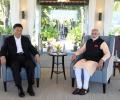
'China physically occupies about 45,000 sq km of J&K as claimed by India, including 3,000 sq km captured in the 1962 War and never returned; and 5,180 sq km ceded to China by Pakistan in 1963.' 'It is hard to justify remaining silent about the return of China occupied Ladakh,' observes Ajay Shukla.

The 15-member Board of BFA included former Japanese prime minister Yasuo Fukuda, former Malaysian prime minister Abdullah Ahmad Badwai, former Singapore prime minister Goh Chok Tong and former prime minister of France Jean-Pierre Raffarin besides former US Treasury Secretary Henry Paulson.

Ahead of the India-China summit, Mahabalipuram, the ancient coastal town near Chennai, has been virtually turned into a fortress with unprecedented security arrangements while the beautification and other preparations touched a feverish pitch on Wednesday.

President Pranab's four-day visit to China that saw him meeting the top Chinese leadership and discussing the sticky boundary issue and cooperation in combating terrorism besides the need for a predictable nuclear regime.
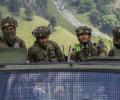
'A breakthrough in eastern Ladakh leading to disengagement and creation of a buffer zone will obviate the need of military deployment through the winter months ahead,' notes Ambassador M K Bhadrakumar.
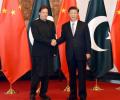
'The scheduling of Imran Khan's visit to Beijing and its focus on the J&K situation underscores that Beijing shares the Pakistani concern that tensions with India are only going to escalate further in the period ahead,' says Ambassador M K Bhadrakumar.

Just like China wants Trump to lose the US presidential poll, it may want Modi to lose the Lok Sabha polls. So months before the 2024 elections, China may take possession of an important area, say one of the Char Dhams, warns Sanjeev Nayyar.
A steady line of supplies is being maintained for the soldiers at the site, official sources said.
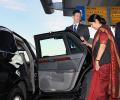
This is her first visit to Beijing after she took over the office last year.

China on Wednesday said it attaches 'great importance' to Sushma Swaraj's visit to Beijing.

There are still a few lingering issues towards the progress of India-China bilateral relations, the approach for dealing with each other seems to be quite different. With Modi-Xi bonhomie strengthening, it seems that India and China are ready to recalibrate their approaches towards each other, says Sana Hashmi.

Modi said India will continue its support to ASEAN for a rules-based security architecture for the region.

He said the Fourth Industrial Revolution will have more importance than the capital.
India's envoy had said that stand-off in Doklam saying it happened because Beijing tried to alter the "status quo" which it should not have.
Swaraj took up the issue with Wang at a bilateral meeting in Moscow on the sidelines of the Russia-India-China trilateral meeting of their foreign ministers.
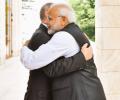
Modi said India and Russia have been friends for a long time and thanked Putin for inviting him for the first-ever informal meeting at Sochi.

Talking about the threat of terrorism, he said "As diverse and pluralistic societies, we both face threats from fundamentalist terrorism. Yet, we do not seem to be able to cooperate as effectively we should in some critical international forums dealing with this subject."
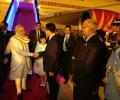
"Hello Hangzhou! PM lands in China to attend the G20 Summit," Modi tweeted.
The BRI, a pet initiative of President Xi, is aimed at promoting network of roads, ports and rail networks all over the world to spread China's influence.

"Speaking of Pakistan, the first word that comes to my mind is 'Iron Pak'," Col Wu Qian told a media briefing

Trouble at a single bank among the top five most connected lenders could wipe out nearly 50% of Tier I capital

'The Chinese forces in the narrow Chumbi Valley are currently in the line of sight and fire of Indian forces poised on the ridges along the Sikkim-Tibet border.' 'Aware of this vulnerability, the Chinese have been eyeing the Doklam plateau,' explains national security expert Nitin A Gokhale.

The Dalai Lama's Arunachal visit is not likely to derail the relationship but it is enough to signal the Chinese that India is also willing to flash the Tibet/Taiwan card should the need arise, says Sana Hashmi.

The readouts by the Indian and Chinese sides on the meeting on Monday between External Affairs Minister Sushma Swaraj and her Chinese counterpart Wang Yi in Moscow bring out that divergences are crowding into the centrestage of their relationship, says Ambassador M K Bhadrakumar.

Chinese President Xi Jinping's visit to India is a time for the two countries to get away from the haze of rhetoric and stale euphoria, says Sana Hashmi.

China's state-run media on Saturday reiterated the country's claim on Arunachal Pradesh, contending that the area is under "illegal Indian occupation".
The papers said India is using the Dalai Lama as a "diplomatic tool" against China for its "vice like veto" against India's membership in the Nuclear Suppliers Group and United Nations ban on Jaish-e-Mohammed chief Masood Azhar.

After visiting two Central Asian countries, Prime Minister Narendra Modi arrived in Ufa on Wednesday on a three-day trip during which he will attend the BRICS and Shanghai Cooperation Organisation summits.

India and China on Wednesday signed in all nine agreements, including the Border Defence Cooperation Agreement and one on strengthening cooperation on trans-border rivers, after restricted and delegation-level talks that lasted over two hours as Prime Minister Manmohan Singh and Premier Li Keqiang met for the second time this year for talks which the Indian leader described as "fruitful and productive".

India on Monday did some plain-speaking with China over its blocking of the Indian bid to get JeM chief Masood Azhar banned by the UN and warned the global community of "serious consequences" if it continues to adopt "double standards" in dealing with terrorism.
The greatest challenge before India is how to strike a fine balance of its relationship between its neighbour and strategic rival China, and the US.

Biden, the first US Vice President to visit India in three decades, welcomed relaxation of foreign direct investment norms in certain sectors but said a lot more needed to be done to remove trade barriers.
He said China was exercising sovereignty in its own territory.

'India in 2020 is a lot better prepared than in 1962.' 'It is no longer a pushover; and anything other than a crushing Chinese military victory will be a major loss of face for China,' observes Rajeev Srinivasan in the first of a three part column.

This will be the first visit of Mukherjee to China as President though he has visited the country a number of times in different capacities. The last Presidential visit to China was by Pratibha Patil in 2010.

Hailing India for keeping "neutral stand" over the South China Sea issue despite pressure from the US and Japan, state-run Chinese media on Wednesday said there are some contradictions and frictions between the two nations but the overall bilateral relations have been developing smoothly.

Modi also said the people of India felt proud that President Xi has twice received him out of the capital.

Prime Minister Narendra Modi has left from Delhi for Brazil to attend the five-nation Brazil, Russia, India, China and South Africa (BRICS) summit slated to be held for two days, starting Monday. Here is his statement ahead of the meet.

India on Monday voiced its concern to China over its plan to build a multi-billion dollar Economic Corridor to Pakistan through POK, even as it assured Beijing of its commitment to consolidate strategic bilateral ties.
